Coming Out of the Ground in Seattle’s Theatre District
July 1, 2013
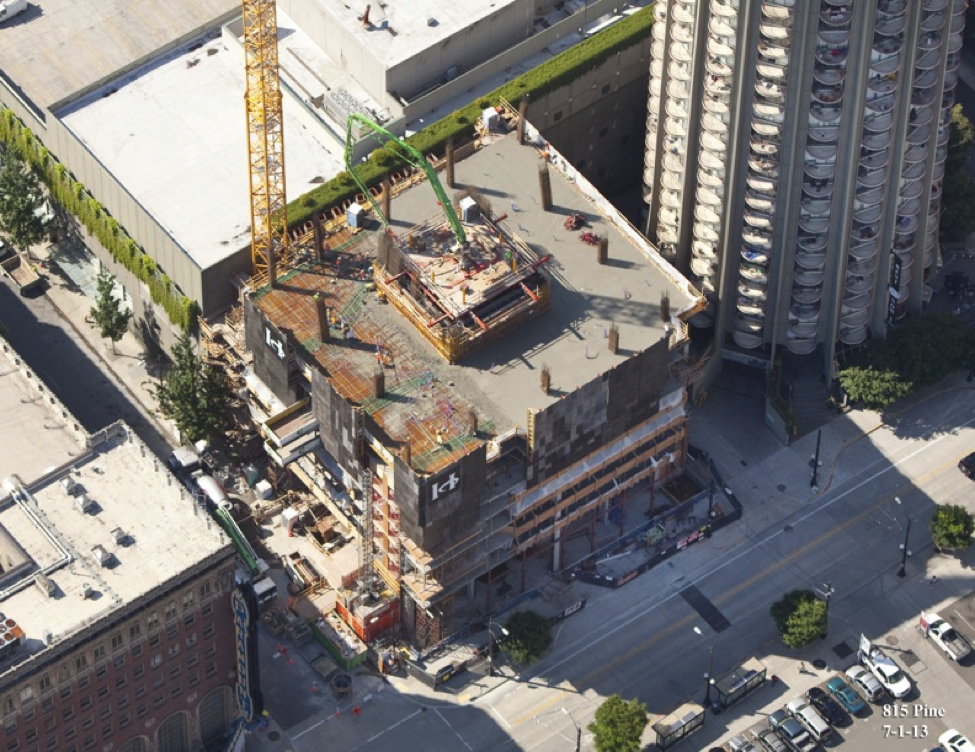
The Holland Partner Group has come out of the ground with a new 40-story apartment building adjacent to the historic Paramount Theatre. This project, with its close proximity to Rapid Ride Transit and Seattle’s retail core, positions itself in the middle of the vibrant downtown. Upon completion this project will consist of 325 apartments, 276 parking stalls, and a restaurant and retail at the ground floor to cater to the theatre clientele.
As part of the Holland Team, Conco is performing all of the cast-in-place concrete, rebar, formwork, shotcrete and concrete pumping for this signature property. The small footprint with minimal lay-down area and five-day form cycle present challenges that require constant communication and coordination with all trades on site. Conco will be utilizing a perimeter protection system and perimeter netting system to ensure the aggressive schedule is met without jeopardizing the workplace. As of August 1, Conco is on schedule having recently completed the 12th floor. Conco will top out the project January 22, 2014.
815 Pine is designed and constructed to achieve LEED Silver status. The project is scheduled to be completed in April, 2015.
New challenges arise for the concrete contractor due to the growing demand for in-fill projects such as Conco’s current Essex-Elkhorn Court Apartment Homes in San Mateo, CA. The City of San Mateo is part of the Bay Area plan drafted by the Association of Bay Area Governments and the Metropolitan Commission designed to find solutions to meet the growing housing needs of the Bay Area. An integral part of their plan is to locate housing near transportation corridors and jobs. The result of doing this would generate a reduction in greenhouse gas emissions due to a less automobile traffic.
Therefore, more projects being constructed are located next to existing commercial buildings and residential complexes. These in-fill projects pose challenges such as noise, site access, and impact on the surrounding neighborhood.
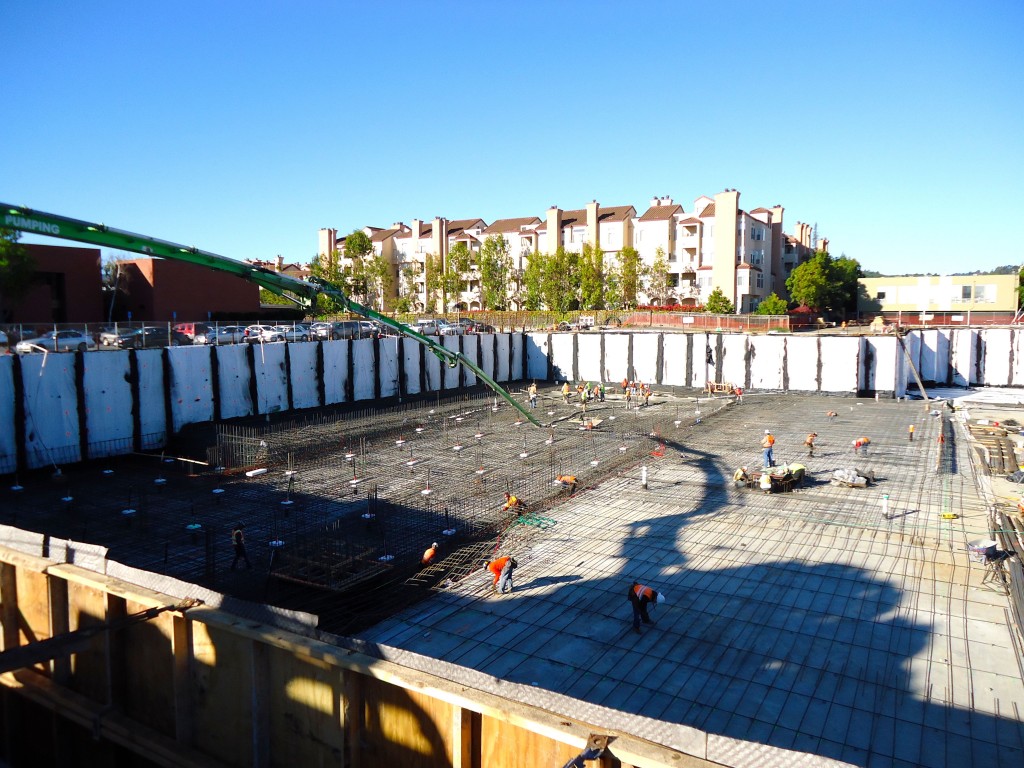
The Essex-Elkhorn Court Apartment Homes will consist of 197 apartment units and have 125,978 square feet of office space with below grade parking for all. The project is being constructed by Barry Swenson Builder.
The Essex-Elkhorn project is sandwiched adjacent to a hospital, day care center and residential housing. Because of this, special attention had to be taken to lessen the impact of performing the concrete work on the surrounding neighbors including scheduling large concrete pours on weekends during designated hours only and reducing the traffic around the site by limiting mixer truck traffic by pumping concrete from one pump to another. The attached clip shows a time lapsed video for accomplishing one of four mat pours scheduled for the project.
Conco’s regional office in Washington completed a 2,880 cubic yard mat pour on April 7th at The Martin–a 24-story luxury apartment tower located in Seattle’s Belltown neighborhood–for general contractor Exxel Pacific.
Located downtown adjacent to Seattle’s Monorail, access and time constraints were a concern. Three pumps–36 meter, 47 meter & 58meter–were used to complete the mat pour, together pumping 450 cubic yards per hour at peak times. Cadman, Inc. delivered the ready-mix with trucks arriving approximately every 80 seconds to fill the mat which measures 7′-6″ at the deepest point.
With 2,880 cubic yards and 275 tons of rebar, The Martin stands as affirmation of Conco’s abilities and reputation.
Concrete package for the San Francisco 49ers stadium
49ers Stadium
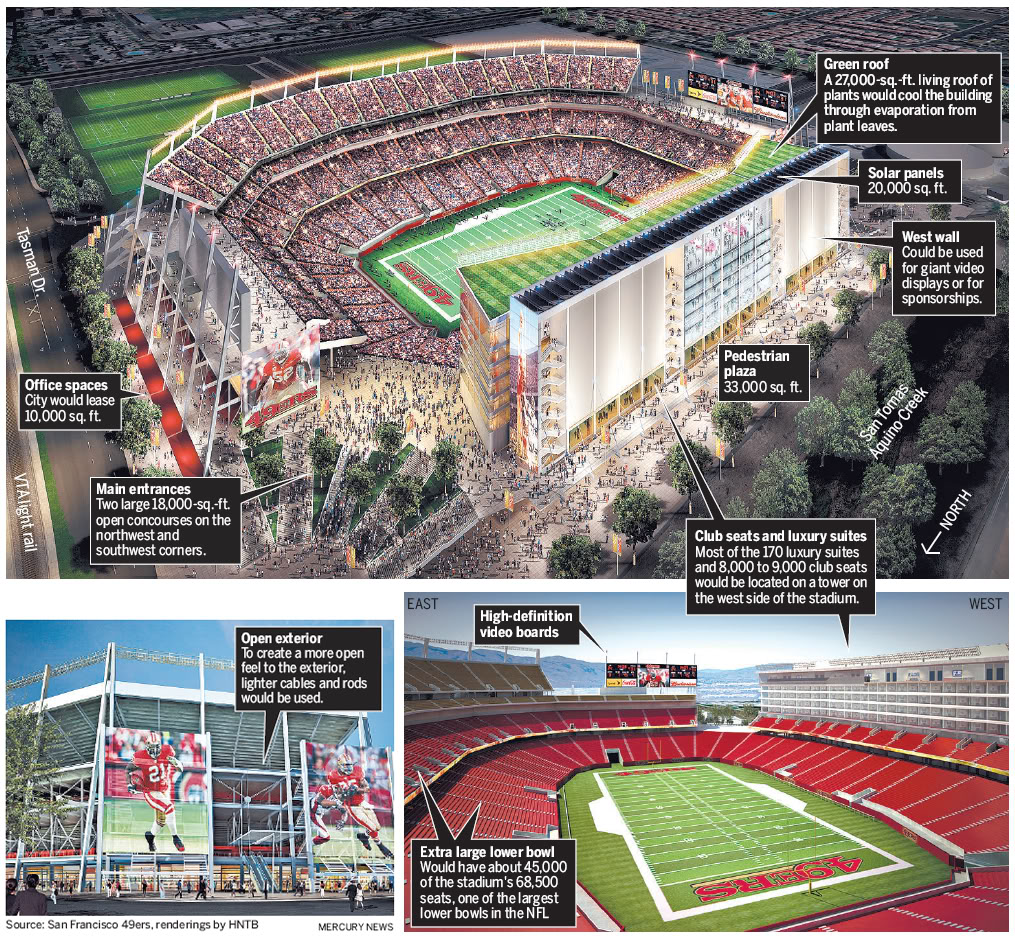
A joint venture between Turner Construction and Devcon Construction has awarded the concrete package to Conco for the $1.2 billion San Francisco 49ers stadium. Designed by architect HNTB, the stadium is scheduled to open in time for the 2014 NFL season.
The project consists of slabs in excess of 2,000,000 square feet and will use more than 65,000 cubic yards of concrete. In order to meet the demands of the ambitious timeline for completion of the foundation, Conco will be working in four separate areas simultaneously. The same approach will be taken for the many deck pours that will need to be completed.
Conco brings to the project its vast experience in public arenas. Among its portfolio of projects include all the cast in place concrete for the San Francisco Giants ballpark (AT & T Park), the foundation package for the HP Pavilion (Shark Tank), all cast in place concrete for the LA Live complex, and ancillary structures for the Seattle Seahawks Stadium.
Visit the Construction Camera page for a live view of the construction.
Wafflemat is one of the most-proven foundation systems ever developed, with millions of square feet of residential and light commercial space built across the United States and Mexico since 1995 – all without a single structural failure.
It is also one of the easiest, and in terms of cycletime, fastest to construct, taking 3 – 4 days vs. 10 – 14 for alternative slabs. Wafflemat conforms to both International Building Code and Post Tension Institute specifications.
To build a Wafflemat foundation, all that’s needed is a clean and level pad, as the system sits directly on grade. No pre-soaking is necessary.
After installing underground utilities, a task made much easier with Wafflemat because the trenching does not have to go under any in-ground ribs or deepened footings, the perimeter formwork is placed directly on the pad.
A series of interlocking Waffleboxes, 8½” or 12” high, 19” x 19” thermal-grade, heat-resistant, patented plastic forms, are then set directly on the ground. Strong enough to walk on, they connect together at the top and bottom with plastic clips supplied with the Wafflemat system and create voids in the foundation. There is only one way Waffleboxes can be installed, ensuring each Wafflemat foundation is laid out correctly – and, to code.
A post tensioned or rebar reinforced concrete slab, usually 4” – 5” thick, is monolithically poured directly over the Waffleboxes. The pour creates concrete beams running throughout the footprint and perimeter. The completed Wafflemat slab then sits on the ground like a raft.
There are two key features that set Wafflemat apart from all other foundations systems, and are the reasons why it delivers superior performance. First, the voids formed by the Waffleboxes act as ‘relief valves’ that absorb heaving soils and eliminate significant structural cracking.
Second, and even though Wafflemat provides one of the stiffest cross sections per cubic yard of concrete, the system has less contact area with the underlying soils when compared with other slabs. And, less contact area means less uplift pressure on the slab when soils heave.
In terms of environmental impact, a Wafflemat foundation uses less concrete and steel, and reduces excavation of soils and accompanying off-haul when compared to other systems. This results not only in lower carbon emissions, but also less erosion and transport of sedimentation in drainage and storm runoff waters ultimately flowing into the ocean. Wafflemat also assists builders in obtaining LEED points, most likely in the categories Energy & Atmosphere, Materials and Resources, and Innovation and Design Process.
Finally, and even though Wafflemat’s track record of reliability is unparalleled, it’s consistently one of the most economical systems in all construction, as reductions in soils prep, materials, and cycletime often produce cost savings of 10% – 20% when compared to other foundations.